
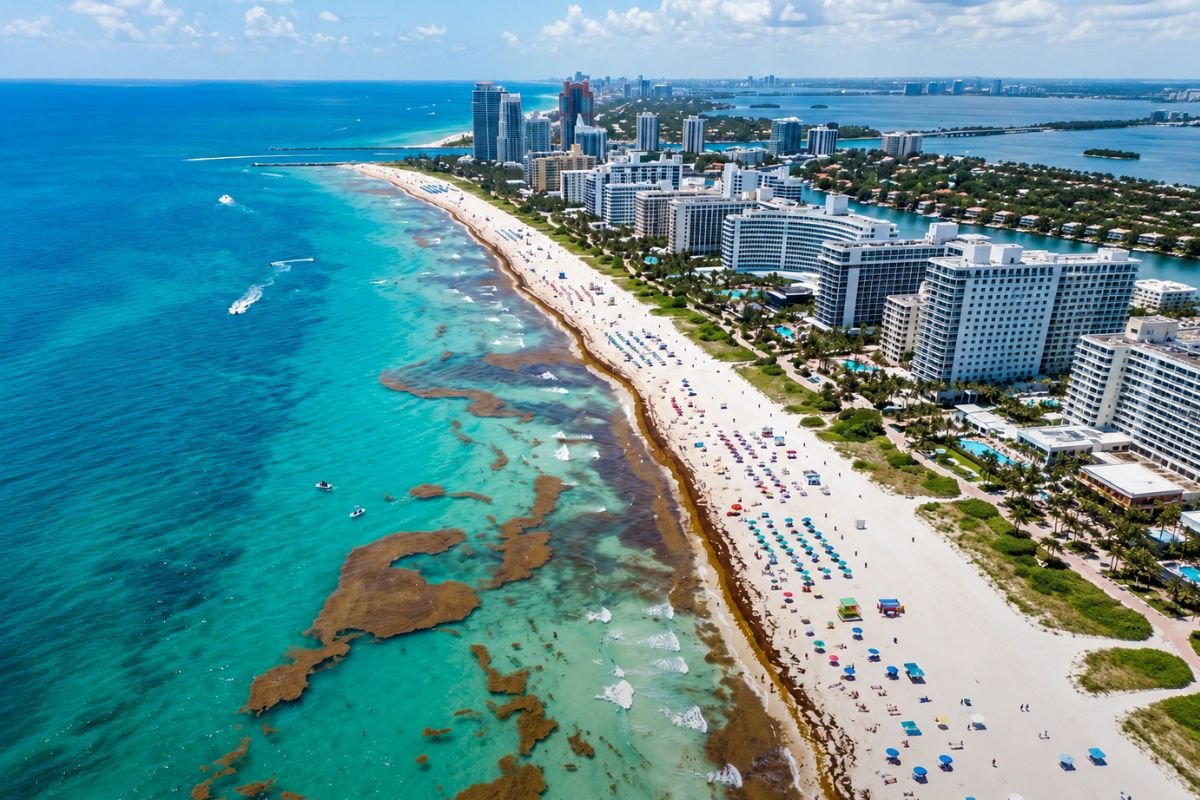

Scientists are sounding the alarm now that biomass is growing by 31%!
South Florida’s shoreline is going through what researchers are calling an unprecedented environmental and financial disaster. Scientists warn that 2026 is on observe to be the worst sargassum season everwith projections suggesting seaweed ranges might even exceed 2025 historic highs.
In January, NASA satellites found a amount of sargassum better than any beforehand recorded January in historical past. By March, biomass inside the Better Atlantic Sargassum Belt had reached its peak 19.6 million tonnes – a rise of 31% in comparison with the identical interval in 2025when the annual whole over the tropical Atlantic Ocean reached 50 million tons, in response to knowledge from The University of South Florida Optical Oceanography Laboratory.
Dr. Chuanmin Hu, a professor of oceanography on the College of South Florida and a pioneer of satellite tv for pc monitoring of the phenomenon, provided a stark evaluation. “As a scientist, it’s disturbing to see how we’ve got recorded increasingly more historic knowledge over the previous two or three years,” he informed CBS Miami. He was equally direct in regards to the limits of intervention: “Nobody can cease the large quantity of sargassum within the ocean. All we will do is put together.”
Tourism {dollars} are in danger when coastlines flip brown
The consequences are already seen alongside Miami’s iconic shoreline. Final week, three tractors spent greater than an hour raking the seashore at South Pointe Park in Miami Seaside as beachgoers navigated dense piles of seaweed that turned the shoreline water a murky brown. At Crandon Park Seaside, a business movie crew was pressured to maneuver cameras to take away mounds of sargassum from their footage.
Miami-Dade County taxpayers spend almost $4 million yearly to take away algae from about 17 miles of public seashores – a value that has steadily risen since systematic cleanups started in 2019. The deeper financial toll, nevertheless, is far better. Di Jin, a scientist on the Woods Hole Oceanographic Institute Ocean Discovery Heart estimates that Florida’s tourism and fishing industries take in roughly 20% of the entire quantity of water $2.7 billion in losseswith whole projected statewide financial injury probably reaching $10 billion by 2026.

The reputational injury will increase the monetary strain. Brena Watson, a traveler from St. Louis who had been contemplating a seashore trip in Miami, informed reporters she was now weighing Las Vegas or New York. “We do not want that in our lives. A seashore vacation ought to be clear, lovely and pleasurable,” she mentioned.
A well being hazard that goes past the scent
The disaster extends past aesthetics and economics. When sargassum decomposes in tropical warmth on the coast, it’s launched hydrogen sulfide (H₂S) — a colorless, toxic gasoline recognizable by the scent of rotten eggs. Analysis printed in Dangerous algae found that in early 2026 cleaning workers in the Mexican Caribbean have been uncovered to H₂S concentrations that peaked at 50.8 components per million throughout the 2025 season, with almost half of all measurements exceeding the Mexican occupational security commonplace of 1 ppm.
The US Environmental Protection Agency has documented hundreds of instances of acute publicity within the Caribbean and factors to an elevated threat for individuals with bronchial asthma, the aged, pregnant ladies and infants. The seaweed additionally bioaccumulates heavy metals, together with arsenic, elevating additional issues about coastal meals chains.
Local weather change and nutrient runoff stimulate flowering
Consultants attribute the accelerating disaster to a convergence of things: the drainage of vitamins from the Amazon, altering ocean currents and warming of the ocean floor linked to local weather change – all of that are creating more and more favorable situations for sargassum progress. The NOAA classifies pelagic sargassum as vital habitat for sea turtles and different marine species, that means the seaweed can’t be legally eliminated earlier than it has already washed ashore, limiting the time for preventative motion.
The phenomenon just isn’t restricted to Florida. In 2025, japanese Cuba issued a most public well being warning as sargassum flooded the seashores. This yr, the complete Caribbean basin is following the identical trajectory – with South Florida as soon as once more immediately in its path.