
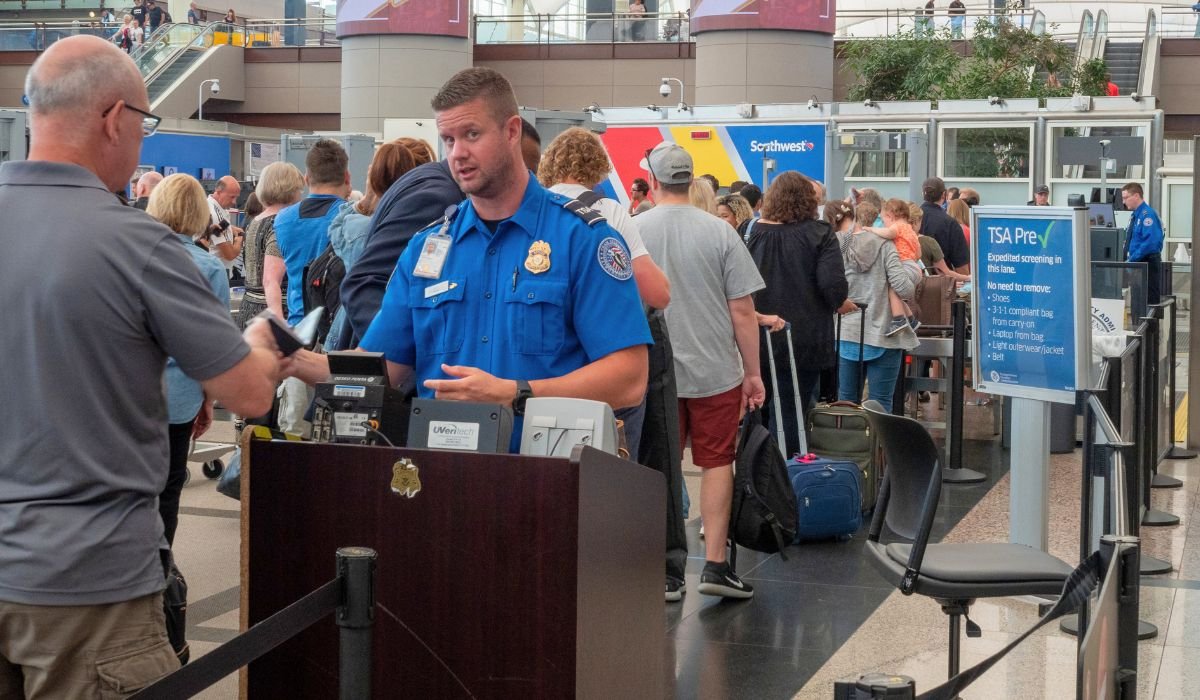

Vacationers touring to the US from visa-waiver nations will likely be required to reveal 5 years of social media exercise beneath a brand new Trump administration proposal that considerably expands digital surveillance of overseas guests.
The draft rule, issued by U.S. Customs and Border Safety (CBP), would create social media revelation a compulsory a part of the Digital System for Journey Authorization (ESTA) for residents of 42 nations, together with Nice Britain, France, Germany, Japan and Australia. Candidates can be requested to record any social media account used up to now 5 years, along with earlier cellphone numbers, electronic mail addresses and intensive biometric information.
The CBP discover, which will likely be printed within the Federal Register, stated officers would additionally accumulate facial photos, fingerprints and different identifiers via a revamped app-only ESTA system. The change is meant to implement an govt order wherein President Donald Trump directed companies to make sure that guests “don’t bear a hostile perspective in the direction of [the United States’] residents, tradition, authorities, establishments or elementary rules.”
The brand new necessities construct on earlier measures. As of 2019, most immigrant and non-immigrant visa candidates worldwide are required to incorporate their social media identifiers on State Division varieties. Extra not too long ago, the federal government has expanded on-line presence screening of worldwide college students and change guests, with consular pointers explicitly directing them to reveal all platforms used up to now 5 years, together with inactive accounts. The newest proposal would develop this extra intrusive “excessive screening” from higher-risk visa classes to tens of millions of short-stay vacationers who beforehand acquired comparatively gentle screening.
The journey and tourism industries are warning that the transfer might have a chilling impact simply months earlier than the 2026 World Cup, which the US will co-host with Canada and Mexico. Trade analysts instructed Skift that the plan provides “a compulsory digital hurdle” for among the nation’s most beneficial guests and dangers deterring “high-spending, low-risk” vacationers. With FIFA anticipating tens of millions of followers to maneuver between North American host cities, any confusion or delay surrounding Esta might unfold throughout airways, inns and stadiums.
Civil liberties groups declare the proposal will strain vacationers to scrub up their on-line lives and punish legit dissent. Privateness advocates on the American Civil Liberties Union (ACLU) say requiring social media historical past as a situation of entry invitations ideological screening and “inevitably encourages self-censorship,” echoing earlier ACLU warnings that passwords and messages shouldn’t change into de facto visa necessities.
The proposal joins a broader wave of frontier know-how. That is evident from official CBP statistics search for electronic devices ports of entry have greater than quadrupled up to now decade, from about 8,500 in 2015 to greater than 46,000 in 2024. Wired not too long ago reported that almost 15,000 telephones and laptops had been examined in a single quarter this yr, the very best determine ever.
A separate evaluation from the Middle for Democracy and Know-how discovered that information scraped from gadgets could possibly be saved in DHS databases for as much as 15 years and accessible to 1000’s of officers. Rights teams warn that combining long-term machine information with 5 years of social media historical past might create a robust, opaque surveillance infrastructure with little judicial oversight.
European governments and regulators are additionally scrutinizing the plan. Retailers in France, Eire and the UK have highlighted tensions between the US proposal and European information safety requirements, noting that blanket assortment of social media identifiers might breach the rules of necessity and proportionality beneath EU regulation. Knowledge switch preparations between the EU and the US, already weak following earlier lawsuits, could possibly be topic to new authorized assessments if the net identities of European vacationers are systematically collected and saved in US methods.
Proponents of the coverage throughout the authorities see it as a logical extension of current nationwide safety instruments. Officers argue that open supply intelligence and social media analytics have change into central to risk assessments and that it’s changing into more and more troublesome to deal with residents of rich allies in a different way from different guests. A senior homeland safety official, chatting with US media, stated this was the purpose “be sure that the privilege of visa-free journey is reserved for individuals who don’t pose a risk to safety or public order.”
Critics counter that the dragnet is each too broad and ineffective. Safety specialists warn that subtle actors can simply purge or compartmentalize their on-line presence, whereas atypical vacationers – college students, households and retirees – will bear the brunt of the brand new paperwork. Tourism organizations concern the proposal, mixed with rising fares and already aggressive border controls, will additional erode the US’ popularity as an open, welcoming vacation spot.
CBP’s discover triggers a 60-day public remark interval, throughout which civil liberties teams, know-how firms, overseas governments and trade associations are anticipated to weigh in. Authorized challenges are thought-about probably if the rule is finalized in its present type, organising a high-stakes conflict between nationwide safety arguments and evolving international norms on privateness and free expression within the digital age.